

Episode 111 · Nov 18, 2026
Olivia Plender: The Rehabilitation of Curiosity — Witchcraft, Art and Women's Medicine



Transcript
Garrick Jones00:00Hello and welcome to this episode of The Curious Advantage Podcast. My name is Garrick Jones, and today I'm not here with my co-hosts Paul and Simon, who regrettably can't be with us, but I am here with a fantastic guest, the artist Olivia Plender. Hello, Olivia.
Olivia Plender00:16Hi. Nice to be here.
Garrick Jones00:18It's so great to have you on the show. Olivia is a British artist and researcher based between London and Stockholm, where you live, I believe. Her multidisciplinary practice explores the relationship between gender, power and knowledge, often drawing on social history, archives and collaboration. She has a very, very curious practice, and I'm fascinated by her approach and by her art, and we're going to get into that in more detail. Her recent solo exhibition, Little Fennel's Complaint, at Modern Art Oxford, explored the history of medicine and ongoing inequalities in women's healthcare. Olivia's work is held in collections including the Tate, and she's currently an artist research fellow at the University of Edinburgh. Welcome to The Curious Advantage Podcast, Olivia.
Olivia Plender01:05Thank you. Hi, Garrick. Great to be here.
Garrick Jones01:08Now, I know you're extremely curious, and we share that in common. I'm really interested in your practice, because you approach your art — and you approach life, it seems — through making and construction and research, learning by doing and doing by learning. These are all things I'm absolutely fascinated by. But let's ask, as we always do: how do you personally define curiosity, and what role has it played throughout your life and career?
Olivia Plender01:44Curiosity is central to being an artist — certainly to my way of being an artist. I was thinking about it before coming on the podcast: what is curiosity? For me it's a compulsion. It's a huge drive towards knowledge. I want to know about things. I want to know how things work. I want to have experiences that are new to me, and different. So curiosity is a kind of encounter with difference on the one hand. And on the other, it's a compulsion — this force that propels me forward. It's always been central to me as an artist. I want to be in the world, figuring out how things work. In terms of becoming an artist — I trained in the nineties at Central Saint Martins, and I originally studied painting. So I was squeezed out of the sausage factory that is Central Saint Martins as a little painter, got myself a studio and a part-time job in a bookshop to pay for it, which was possible in those days. And then it was just me in a room, and I thought: is this it? Is this what being an artist is? I thought, this isn't going to work for me. At the time I didn't know much about different kinds of practice — I thought that's what art was. But it very quickly became clear to me that I had to find some way of getting out and about. I wanted to meet people. I wanted to talk to people. I'm very curious about what makes people tick. I'm always curious about group dynamics, people's emotions, society, how society works. And one of my big loves is history, particularly social history. So I started going out into archives, and going out talking to different people — talking to academics, to community groups, to community organisations. In a way I ended up with an artistic practice that's a little bit hard to define in terms of mediums. On the one hand I do what in our field is often called socially engaged art practice, where I work with a lot of community groups and do a lot of things collaboratively. But then I also hang out in my studio on my own, and have that space of reflection.
Garrick Jones04:22I want to explore that in more detail, because it's fascinating — how you get into society, and how that informs your art. For people who don't work in the arts, or maybe aren't used to this approach, what do you think they can learn from the way you explore ideas and approach problems? And why is that part of your artistic practice?
Olivia Plender04:43One of the central things with art and being an artist is imagination. Along with curiosity, that's the most important thing. If you haven't got an imagination, you can't be an artist. And there's a playful side to imagination — you have to retain some of your childlike joy in the world and in making things. But then there's the other side of imagination, which is being able to imagine different worlds, different societies, different systems. In terms of my interest in history, I'm always very interested in thinking about how things were different in the past, and how things will be different in the future. We can't predict what the future is going to look like, but without imagination we're not going to be able to conceive of that difference at all. It also takes imagination to understand that people are different. People have different cultures, different beliefs, different ideas about things, different ways of operating. That interests me too. There's something in imagination which is also connected to empathy — being able to imagine yourself into someone else's circumstances. With empathy there's a kind of porousness, where the border between me and you becomes less hard. I start to wonder about how you're feeling, what you're thinking, what your life circumstances might be.
Garrick Jones06:18I love that. To take it further — your recent exhibition at Modern Art Oxford, which you called Little Fennel's Complaint, didn't have much painting in it. There are sculptures, objects, other things. How did your practice evolve from painting at Saint Martins into what you make now?
Olivia Plender06:45On the one hand, I've always had academic tendencies, but I'm also really bad at fitting into institutional shapes. I was a school dropout — I left school at sixteen, and art school in those days was the only place that would take you if you didn't have any qualifications. So in a way I had to figure out something to do with my academic tendencies that wasn't academia, because that wasn't going to fit me.
Garrick Jones07:18That's amazing, because research is so much at the heart of what you do — and proper research, proper academic work.
Olivia Plender07:27These days I spend a lot of time with academics, and I ended up eventually doing a PhD. I got there in the end. So I've got one foot in and one foot out, but I find I have to be playing by my own rules somehow. I think that's similar for a lot of artists. If I'm in an institutional structure, I always find myself wanting to question it, rebel against it, critique it, figure out why it's like this. In terms of getting to being the kind of artist I am now — when I was younger and realised that sitting in the studio making paintings wasn't going to work for me, I had quite a wild youth and got involved with lots of different things. For example, at one point I was part of a coven of witches in South London. That was my introduction to things like feminism. There was me, aged eighteen, hanging out with a lot of women who were in their seventies and were somehow veterans of the feminist movement, but now did this kind of witchcraft practice. So in a way I'd been involved with a social movement — in a sense, two different social movements: feminism, and the neo-pagan movement that was quite big at the time. And then when I started looking around in archives, I got very compelled by trying to understand what that was all about. Why was I so invested in that? What was it about the way these groups operate that attracted me? How does a group construct identity? How does a group construct a group identity strong enough to hold it together, even if you're doing something seemingly as wacky as witchcraft? We did a lot of the things you'd imagine — dancing around naked at places like the Avebury stone circle. But those groups are very, very compelling. There's a community aspect to it. So I started wanting to know about all of that, and to figure out what it was all about. And then also social change — as I mentioned, I've always been involved with feminism, I'm very engaged with women's rights and thinking about everything that involves, and the history of feminism. I became very interested in thinking about how you make social change happen. One project I did was about the suffragette movement, and I was particularly interested in a group called the East London Federation of Suffragettes. I was looking at that movement and thinking: how did they make it happen? Women did win the vote. It was a great success in many ways, that early twentieth-century campaign for votes for women. And they did extraordinary things. They went to prison. They acted in ways that were not considered respectable for women at the time. So how did they manage to hold the whole group together? These were the questions I started exploring. I spent a lot of time in archives — there's a social movement archive at the London School of Economics, which is great, places like that. But then at some point I thought, I don't want to just be looking at black and white photos of people doing things in the past. I also need to continue to spend time with contemporary social movements. How do they view these histories? What do they think and feel? How do they hold themselves together as groups? So that's when the social part really started. That's when I launched into the kind of work I do today.
Garrick Jones11:44I'm so fascinated by art as an archival practice, art as a research practice, art engaging with difference and with different groups outside of norms — and then that exploration becoming part of the practice as well as part of the research. I have a relationship with the LSE too, and I'm fascinated by its role in the women's movement — the suffragettes, how it supported all of that, how it was among the first to start giving women degrees. It was also a home base for people like H. G. Wells, the Theosophist movement, which was also outside the norm at the time, the Fabian movement — all of these are part of the structure of people trying to change society at the end of the Victorian era. Before we go into how you make your art once you've done all your research, and how that turns into objects, books, exhibitions and artworks themselves — what was fascinating about the neo-pagan movement? Why was that so much part of the feminist tradition at the time?
Olivia Plender12:56You've touched on the Theosophical Society and theosophy as a movement in the early twentieth century. The roots go back quite far, because in the nineteenth century you also had the modern spiritualist movement — séances, table-turning, spirit mediums, all that kind of thing. I've had a good look at those movements as well. I've mentioned this to you in conversation in the past, but recently I've been training as a spirit medium at the College of Psychic Studies, as part of my investigations, let's say. But with that history, it became entangled in the nineteenth century. With séances, in the world of spirit mediumship, these were spaces that were dominated by women. It was often a practice you could do at home, so it stayed within that respectable realm of where women were supposed to be. But it became tied up with a lot of radical causes in a really fascinating way. These nineteenth-century mediums — when you read reports of what they got up to, they'd be channelling spirits. So the ghost of Abraham Lincoln, or some usually male, dead political thinker might come through. Thomas Paine was a popular one as well. And the female medium would be channelling, say, Thomas Paine. Thomas Paine's voice speaks through her body and gives a lecture at a séance in the north of England about why women should have the vote. Which is amazing. These women believed in what they were doing. I'm never very interested in the question of whether it's true or not — for me that's completely beside the point. But there was some kind of mechanism within that context, that very not-normal context, which allowed them to get their point across, allowed them to explore ideas.
Garrick Jones15:06Let's not kid ourselves — so many people have beliefs that are outside of the norms that we don't talk about in established society. When you look at the statistics of people who are partly involved in non-traditional groups around the world, it's remarkable. You can see the whole thing about magical thinking that's taken root in the United States at the moment, which for a scientist is bizarre, but as a social phenomenon you've got to acknowledge it. As a politician you've got to build it into your reckoning. So your point about whether it's true or not is absolutely spot on for me. Whether it's true or not is not the issue. The issue is how many people believe this, and what's the culture of this very different group, and how do we work with them?
Olivia Plender16:03Completely — and why is this compelling to people? With spiritualism in the nineteenth century, it also had a relationship to education, to knowledge production. To give another example, spiritualists tended to be people who weren't admitted to universities. So women, working-class people. In the United States it got very tied up with the abolitionist movement, the movement against slavery. A lot of the spiritualists saw themselves as educators — they called the spiritualist churches lyceums, and they saw themselves as educational institutions. And then you get these crazy stories. Another popular spirit was Emanuel Swedenborg, an eighteenth-century Swedish enlightenment philosopher.
Garrick Jones16:55There's the Swedenborg Society here in London, yes.
Olivia Plender17:02Swedenborg was a scientist, but also a mystic — which back in the seventeenth and eighteenth centuries was more common as a combination.
Garrick Jones17:11Newton — sorry to interrupt you — but Newton was famously not only a scientist but also an alchemist.
Olivia Plender17:17Exactly. So the boundaries of disciplines were placed very differently in the past.
Garrick Jones17:25And even today. What's striking me about this conversation is that out of what we'd see as the wacky, or the fringe, or the anti-establishment — the things that are different, those kinds of groups and movements — out of those movements comes mainstream society today, where women have the vote and we expect as much equalisation within society as possible.
Olivia Plender17:53Exactly. Spiritualism was also a space to practise ideas about democracy and community. Of course in the nineteenth century democracy wasn't the norm; that wasn't how politics worked. And with Swedenborg, just to finish the story, there are these wacky stories about the spirit of Swedenborg coming through and teaching people to read, and things like this. You wonder what was going on there. There was some kind of educational process going on. People coming together and engaging with dead philosophers and thinkers. And their attitude was very much: well, you won't let us into the universities, but we don't need them anyway, because we can have a conversation with Aristotle directly if we want to. We don't need it mediated by academia. So there's something very interesting there. And as you say, ideas do move out of the periphery into the centre.
Garrick Jones18:57They do. The LSE, for example, came out of quite a wacky social revolutionary movement amongst intellectuals, which started to include people like Gandhi, and the Theosophical Society and others — all on the periphery. But the people and the ideas that were going on there, and the requirement for women to have the vote and also to be educated… At the time, if you wanted to get a university degree you went to Oxford or Cambridge, and you had to be signed up to become a vicar or a reverend, or you had to do a theology degree — for men. That was part and parcel of how the whole game was working. Then it changes, and the LSE starts to establish itself and starts to give degrees and PhDs to women. And then of course that spreads around the world, which is an enormous impact — but all coming out of people who were prepared to go beyond the fringe, to go elsewhere.
Olivia Plender19:58And imagination is central to that. In these small groups, which might seem quite strange, they were trying to imagine a different society. They imagined equality into existence, in some sense.
Garrick Jones20:14And even that has come to the centre now, because so much of business strategy-making has imagination, creativity, curiosity and visualisation built into it. If you talked about visualisation in scientific scenarios a hundred years ago, you'd have been thrown out. Whereas visualisation is now often at the heart of how people organise their businesses. So how does this turn into art? How does it turn into objects in an exhibition for you?
Olivia Plender20:46Lots of different ways — and that's always the tricky part. I get so interested in things, and then I get lost in the research and lost in conversations with people, and just want to do that forever. But at some point it has to turn into an exhibition. I look for the right medium, the right form — medium in the sense of form of art-making, rather than spirit medium, in this case. I have certain things that I'm good at. I know how to do drawing, painting and so on, but I work with any and every medium. So I'm looking for the right form, and then I have to figure out how that works. In the past I've made video, I've made sound pieces. And for the recent exhibition at Modern Art Oxford there was a lot of work which was installation-based, because I wanted people to really come into the space and encounter it with their body. I wanted to put the audience in an environment that they would move through with their body and feel something — to give them some kind of experience. But there were also other works. There was one very elaborate embroidery piece that I did, which was an insane project to embark on — it took me more than a year to make, because embroidery is so labour-intensive. That came about because it was a work looking at the early modern period and the witch trials, thinking about those as a kind of demonisation of women's healthcare practitioners — midwives and other healers from that time. In a way it had to be embroidery. I tried out lots of different things — drawing, painting, trying to make a video at one point. And it just didn't work. Then as soon as I started doing the embroidery I thought, this works, this makes sense — because it's associated historically with women's work, and something about the labour and the amount of time it takes, the laboriousness of working with textiles, made sense with the topic and with the feminist subject matter. So it works like that. I try out a lot of different forms, and then eventually I settle on one and think: this is the right shape for this idea, this should take shape in this way.
Garrick Jones23:25I'm fascinated by embroidered objects and embroidery, because it's so craft-driven, and as you say, labour-intensive. It makes me think of the most expensive objects in Britain, aside from the crown jewels — and I think they might be valued as much as the crown jewels — which are the tapestries and embroideries of Henry VIII, still hanging at Hampton Court. These are objects the courts would take around with them, because courts were more mobile then. These things survive hundreds of years if looked after. And they also contain records. We've got the Bayeux Tapestry at the moment in London on show — also an incredible record. Women for sure were embroidering and making this thing happen, recounting their tales, putting their humour and their ideas into these objects. The thing I love about your embroidered objects is that you encounter them, you don't know what they are, and then you start to unpick them. They cause you to question. They cause you to go into the subject. You come in off the street, you encounter this object, and the object has power inasmuch as it makes you question, it makes you curious, it makes you want to know more. And then you find your brain starting to be filled up by the ideas that you've put forward.
Olivia Plender24:52When I'm making exhibitions I always think of it as trying to create almost a honey trap. I am very interested in beauty, in craft, because for most people that's what they're attracted by — or that's their idea of what art is. And there's something about the handmade. That embroidery piece, which is called The Witches' Sabbat — because it took me a year, and it was insane, it was three metres high, trying to do that by hand… There's something compelling about that. People love the handmade. The eye is drawn to it.
Garrick Jones25:33Did you do it all by hand? By yourself?
Olivia Plender25:40I did it all myself, yes. If I'd known how much work that was going to be, I might not have launched into that one.
Garrick Jones25:49You almost can feel the encounter with the maker as well. You feel that person who's made that thing. It's so human — we connect as human beings. What other kinds of objects do you make that come out of the research?
Olivia Plender26:08In that exhibition there's one which I should of course mention because of the name of your podcast, which is called The Rehabilitation of Curiosity. It's this enormous hanging mobile — it hangs from the ceiling — and it's based on a cabinet of curiosities.
Garrick Jones26:20Exactly. That's one of the reasons why I reached out.
Olivia Plender26:39Currently I'm very interested in the early modern period — this period around the seventeenth century when you have the transition from medieval to modern. Cabinets of curiosities were something from that time. If you were a prince at that time, you wanted to have your cabinet of curiosities as a kind of prestige object, which would be full of objects representing all the knowledge of the world — according to Europeans at that time, what people in this part of the world thought knowledge was. You'd have objects from natural history, objects from all the colonial exploration that was happening at that time, objects from everyday life. A huge variety, representing all the knowledge of the world. Like a kind of museum in a cabinet. I was really interested in these as a map of what people thought knowledge was then. And also because it's this strange combination of things you recognise from the present — you think, okay, this is the seeds of the kind of institutions we have today, or this is the seeds of ideas we have about what medicine is. The history of medicine being something I'm really engaged with right now. But then there's also this part which is the medieval part — the example you gave of Newton being an alchemist — these other ideas about knowledge that still existed at that time. So this hanging mobile: each individual piece is an image of an object that represents a different branch of knowledge. The way it lives in the space, hanging from the ceiling, some people have related to it as if it feels almost like votive objects — like you might have in a Catholic church, where if you have some problem with your hand and you want to get your hand healed, you call on the saints, and you might go and place an image of a hand in the church in thanks.
Garrick Jones29:07Still happens today, a lot.
Olivia Plender29:12Absolutely. But this hanging mobile also represents — the main thing it's representing is humoral medicine. I was very interested in that system. It's a completely different paradigm, a different idea about how the body works, and it was the main idea within medicine at that time, the main theory of how human health operates.
Garrick Jones29:32Yes — the humours. Phlegmatic… I can't remember them all.
Olivia Plender29:38It's blood, black bile, yellow bile and phlegm. I looked it up before I spoke to you, because I thought otherwise I'm not going to remember. It comes from ancient Greece, but it was still going a thousand years later as an idea. The idea was that they get out of whack, they get out of balance, and the role of a doctor is to try and restore the balance of the humours. So we know about practices like bleeding, and so on.
Garrick Jones30:02Just as an aside — one of my favourite things about medicine in Georgian Britain was that you paid your doctor a subscription while you were well. And as soon as you got ill, he stopped being paid. So it was in their interests to get you back to being well as quickly as possible. A fantastic economy, I would think.
Olivia Plender30:28How interesting. So it's a bit like health insurance. That's really interesting.
Garrick Jones30:34Why did you call it The Rehabilitation of Curiosity? Rehabilitation.
Olivia Plender30:44I was interested in what curiosity meant in the seventeenth century, in the early modern period. When I was working on the exhibition I was in Oxford speaking to a lot of historians of medicine there. And there's this suspicion that medieval society had towards empirical thinking — the idea that you would look around you at the world and observe things and draw conclusions and make knowledge from your own observations. Because of prevailing… basically because of religion, knowledge came from a book. Knowledge came from the Bible.
Garrick Jones31:29Yes — the ideologies of the church, received knowledge. Or from the king, or from the pope.
Olivia Plender31:37So to look around with your own eyes was suspicious. It broke hierarchies. Who are you to be the one creating knowledge? But also, it's a different source of knowledge than the Bible. In terms of the history of medicine, the people who used empirical thinking in order to inform their medical practice, prior to the institutionalisation of medicine in the early modern period in the seventeenth century, was women. It was the local women in the village who knew a bit about herbs. They would observe what this or that plant was doing to people when you gave it to them for their ailments and complaints. Or they might observe, my sheep have eaten from this patch of the field — what is it in this patch of the field that's curing the sheep of worms? And then apply that to humans. This is an argument, of course — we don't know — but there is an argument that feminist medical historians make, that the people who were using empirical methods were actually, in a way, the lowest in society: the local village woman. And then when you got to the seventeenth century it was still bumpy, the idea that we observe the world and that's how we know things. It still had a very tricky transition into academic culture. But there was this sort of rehabilitation, in a sense, of that kind of curiosity.
Garrick Jones33:27Are you saying rehabilitation into the establishment — because it became more male-dominated, and medicine became male-dominated, and then these herbal practices and folk practices and folk medicine were demonised in some way?
Olivia Plender33:45Basically, yes — but at the same time absorbed. It was both. Folk medicine was seen as trash by the establishment. And then with the institutionalisation of medicine — in the UK, the Royal College of Physicians was the first real medical organisation to be recognised, and at that time recognised by the crown. Of course it was one hundred per cent male-dominated. They had to do a kind of double motion. On the one hand they were trying to kick women out of the field of medicine, but on the other hand keep the bits that they wanted, keep some of the knowledge. The most absurd example is when you had the rise of male midwives — but they weren't very good at it, so they had to somehow get the knowledge off the female midwives while simultaneously kicking them out of the field, so that they could dominate the field. Or — we often talk about Western medicine as opposed to other systems of medicine. But in the early modern period you had all these colonial plant explorers who would go out into the world to bring back plants. Part of what they were bringing back was indigenous knowledge. They went to great lengths to try and find out what different indigenous communities were using these plants for.
Garrick Jones35:21The Royal College of Physicians has this incredible library with all of this knowledge — esoteric knowledge, occult knowledge. They've got John Dee's library in there. They've got the remnants of Francis Bacon's library in there. Still today, in the centre of London, and accessible. And all the colonial people — Darwin came back with local knowledge, and so on. As you say, it's this weird intersection between the establishment, the centre and the periphery, perhaps.
Olivia Plender35:50Absolutely.
Garrick Jones35:51How does Dr Richard Napier fit into all this?
Olivia Plender35:55He's an amazing character. His medical case notes are in the Bodleian Library in Oxford. He was a late sixteenth-, early seventeenth-century doctor. He practised humoral medicine, and his main diagnostic tool was astrology. I came across these books when I was researching for my exhibition and thought, oh my God, these are amazing, I have to look at these. But I also couldn't make any sense of them. I had to get a bunch of historians involved to help me decipher his incredibly bad handwriting — which obviously people still make jokes about, doctors' handwriting being bad. But they're fascinating. When I first looked at them I was very down on humoral medicine. I arrived at this material very invested in, you could say, a progress narrative about medicine — the idea that medicine was bad in the past, unscientific, wasn't going to cure anything, and that we've over time got cleverer and cleverer, and modern medicine is the thing, modern medicine is great. But then through some of my conversations with the medical historians — there was, for example, this really brilliant woman called Erica Charters in Oxford, who said, I think we should bring back humoral medicine. And this blew my mind. I was like, really? Why would you say something like that? And then we were looking at these Napier books together, these medical case notes, and she said, well, the thing is, there's something about humoral medicine and his method which was very much addressing your health, your individual body, in relation to the environment around you. So literally the environment, but also your community. And the heavens as well, because they're interested in astrology.
Garrick Jones37:55It's contextualising healthcare, and contextualising the individual, in a way that perhaps we forget about.
Olivia Plender37:56Exactly. And there's also something about this method — even if we agree that astrology isn't a great tool for diagnosing your complaint, there's something in the method which forced him to take very, very detailed case notes. So he did a lot of listening. And then he was keeping these notes over decades, seeing the same patients over decades, and could cross-reference: well, I tried such and such a remedy on this person who had something similar twenty years ago, look it up, try it on this other patient.
Garrick Jones38:31Mercury was retrograde at the time.
Olivia Plender38:39But there's something about listening. And I was thinking how contemporary healthcare — of course we've got better at the science, like biomedicine, which is the dominant paradigm today, of course we're better at the science. But there's a problem within the culture of medicine, that doctors are not very good at listening to patients. That has somehow gone out the window. And this comes up particularly in relation to women's healthcare. There's a really strong drive at the moment from women's health activists — there's been a lot in the media in the last couple of years — talking about this phrase, medical gaslighting. You go to the doctor, you have a complaint, and you come away with antidepressants, being told that it's all in your head. This feeling that you're not being listened to somehow. So I was interested in that. I thought, okay, maybe in some ways Richard Napier, and the medical paradigm he was operating within, was good for some of the things that contemporary medicine is not good for. He seemed to do a lot in terms of helping people make meaning out of their experiences. Today that would not be part of the role of a doctor. Whereas back then — or at least the way he practised medicine — it seems like that was very much part of the role of the doctor. Helping people somehow make meaning out of what's happening to their body.
Garrick Jones40:10The fascinating thing about this conversation is that relationship between the rational and the irrational, or the periphery and the things that are not necessarily accepted — the difference, the things on the outskirts. And yet if you're curious in any way, you're going to encounter those things. We encourage people not to be fearful. We encourage people to open the door and go through, and if they're feeling afraid, to ask themselves why they're feeling afraid. Are they in danger, or is it just because it's out of their contextual framework, out of the things that make them feel comfortable? And if they're not in danger, then embrace it and go forward and learn. But that relationship between the rational and the irrational really throws that into sharp relief. How do you balance both of those in your practice?
Olivia Plender40:58I do all the academic stuff, as I've said — looking in archives, reading, that kind of thing. But then there has to be some kind of experience as well for me. There has to be a way of developing my imagination. So for example, I keep a dream diary, and always have, and that's a great source of imagery for me. Strange things come up. Strange combinations. Suddenly this person is connected with that idea in a way that you wouldn't have done rationally, you wouldn't put those things together rationally. And then, as I mentioned earlier, I'm currently doing this training at the College of Psychic Studies, learning how to become a spirit medium. For me, something like that is quite psychedelic. I'm fascinated by what they do, because I do see it as some kind of practice. With mediumship, it's about talking to the dead. It's about helping people with grief. There's something within it about helping people with emotions, helping people think about their relationships to their family. So there's something in it which is very like what a therapist does. We could see it as some kind of healthcare practice. There's a set of skills that are very interesting. But I also find it completely psychedelic. When I go to the course, I come home and my dreams are suddenly in Technicolor. My inner world goes crazy. I suddenly get images popping into my mind from nowhere. So I really enjoy it as a way of helping me tap into something a bit more visionary, you could say — some very rich source of imagery that I'm not totally sure where it's coming from. Maybe it's coming from my own unconscious. The College of Psychic Studies would say somewhere else.
Garrick Jones42:58You're amazingly not afraid. You're not afraid to go into the unusual, to go into the taboo, which is amazing and really encouraging for me. I'm going to ask you in a moment what the one thing is you want to leave our listeners with. But before that, I have to ask: beyond your current work, which is really all about curiosity in so many ways, what's something you're genuinely curious about right now?
Olivia Plender43:34Currently I'm obsessed with the Middle Ages, I think because it's so strange to us. I've been reading Julian of Norwich, this anchorite nun from — I think it's the fourteenth century. And I've been looking at people like Hildegard of Bingen, the twelfth-century abbess, polymath, scholar, mystic.
Garrick Jones44:01Yes. What a lady. Composer.
Olivia Plender44:03Totally. Absolutely. So I'm really fascinated by the Middle Ages, and I'm not sure what I'll do with this, if it turns into any kind of project or not. It's a huge time span — medieval times is almost a thousand years of history. But it is so different to today. The way they think and feel is so incredibly different to today that I'm fascinated by that.
Garrick Jones44:31Their worldview. We've had such a phenomenal conversation. I could talk to you for hours — I know I could. We've talked about becoming an artist, and about how curiosity is so much a part of your practice. We talked about the relationship between that and archival research, and research in general — going out, being curious, and then turning that into exhibitions and art. We talked about imagining different worlds and the importance of imagination; about not being afraid of areas like neo-paganism and the taboo, the things on the periphery. We had a great conversation about that relationship between the rational, the irrational, the periphery and the establishment, and going beyond what makes us feel safe and secure. You're interested in understanding people and groups, and how they define their identities. We talked about how, as an artist, you like to play by your own rules, and that takes you into some very interesting places. And you're interested in how you make social change happen — the value of archives, not being afraid of difference, and how that translates into objects and art and things that reflect the work as you synthesise it and take it forward. Like your amazing embroidery work, or The Rehabilitation of Curiosity, which looks at the nature of medicine and where that's come from. And we talked about the history of the irrational, the history of the women's movement and the history of feminism. We've touched on a lot in a very short space of time, Olivia. Thank you. So, what's the one thing you'd want to leave us with, if you can?
Olivia Plender46:31I guess my final thought would be around what I'm interested in, in a way, which is unsettling our norms. So if I had final words to listeners, it would be: how can you unsettle your own norms and certainties about how the world works? Or what knowledge is? Or your own belief system and structure?
Garrick Jones47:03Just brilliant. Thank you. As an artist, you continue to challenge me and us. And thank you for doing such a great job. I really appreciate it, and I appreciate your art a lot. That's been a great conversation. Thank you for joining us, Olivia Plender.
Olivia Plender47:18This was a lot of fun. Thanks, Garrick.
Garrick Jones47:21You've been listening to The Curious Advantage Podcast. What are you curious about after this conversation? Please leave us a review on Apple Podcasts or Spotify. Join the conversations with us on LinkedIn. Our new book, The Curious Imperative: Why Questions Beat Answers in the Age of AI, is coming out this fall, exploring why curiosity matters more than ever in a rapidly changing world. Subscribe, stay curious, and we'll see you next time.
In the early modern period, looking at the world with your own eyes and drawing your own conclusions was a suspicious act. Knowledge came from a book. And the people doing the observing anyway were very often the ones nobody would let into a university.
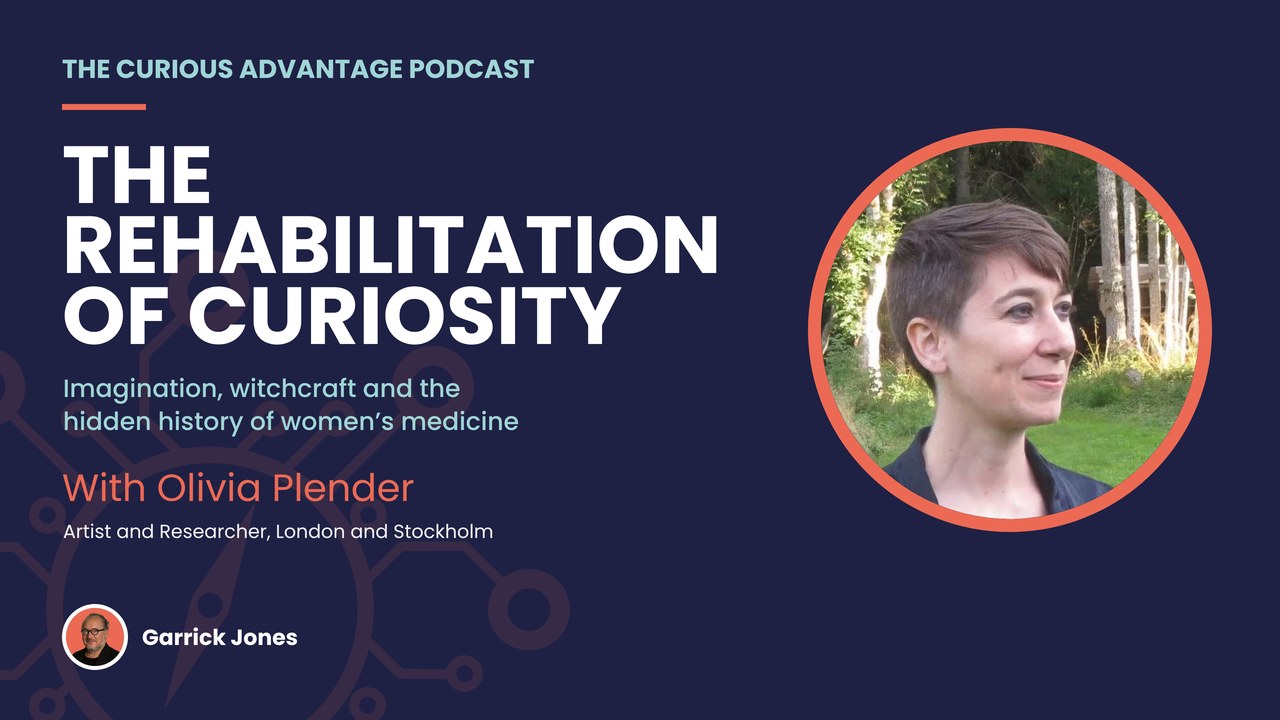
Garrick Jones is joined by the artist and researcher Olivia Plender, whose work sits where gender, power and knowledge meet. Her solo exhibition at Modern Art Oxford, “Little Fennel’s Complaint”, took on the history of medicine and the inequalities still running through women’s healthcare, and included a hanging cabinet of curiosities she calls “The Rehabilitation of Curiosity”.
The conversation starts with imagination — which Olivia makes the twin of curiosity, and ties directly to empathy — and then travels a long way. Through a coven in South London that became an eighteen-year-old’s introduction to feminism. Through nineteenth-century spirit mediums who channelled Thomas Paine to argue for votes for women, because the lecture halls were closed to them. Through Dr Richard Napier, the seventeenth-century physician who diagnosed by astrology and whose real skill turned out to be listening. And into why “medical gaslighting” is an old problem in new clothes.
Olivia leaves us with a question worth carrying around: how can you unsettle your own norms?
In this episode:
- Imagination as the twin of curiosity, and what it has to do with empathy
- School dropout to PhD, and what it takes to play by your own rules
- A coven in South London, and an eighteen-year-old’s introduction to feminism
- Séances, spirit mediums, and women arguing for the vote from the only platform open to them
- Lyceums, abolition and the knowledge built outside the university
- The Witches’ Sabbat, cabinets of curiosities, and why curiosity needed rehabilitating
- The village women who used empirical methods first — and the colleges that shut them out
- Dr Richard Napier, astrology and the art of listening, and what medicine lost when it stopped
Find Olivia at oliviaplender.org
“Little Fennel’s Complaint” at Modern Art Oxford
The new book from Paul Ashcroft, Simon Brown and Garrick Jones titled "The Curious Imperative" is out now. Find out more here
Watch on YouTube here
Enjoyed the conversation? Leave us a review and join us at #CuriousAdvantage.
Listen and subscribe