

Episode 110 · Nov 4, 2026
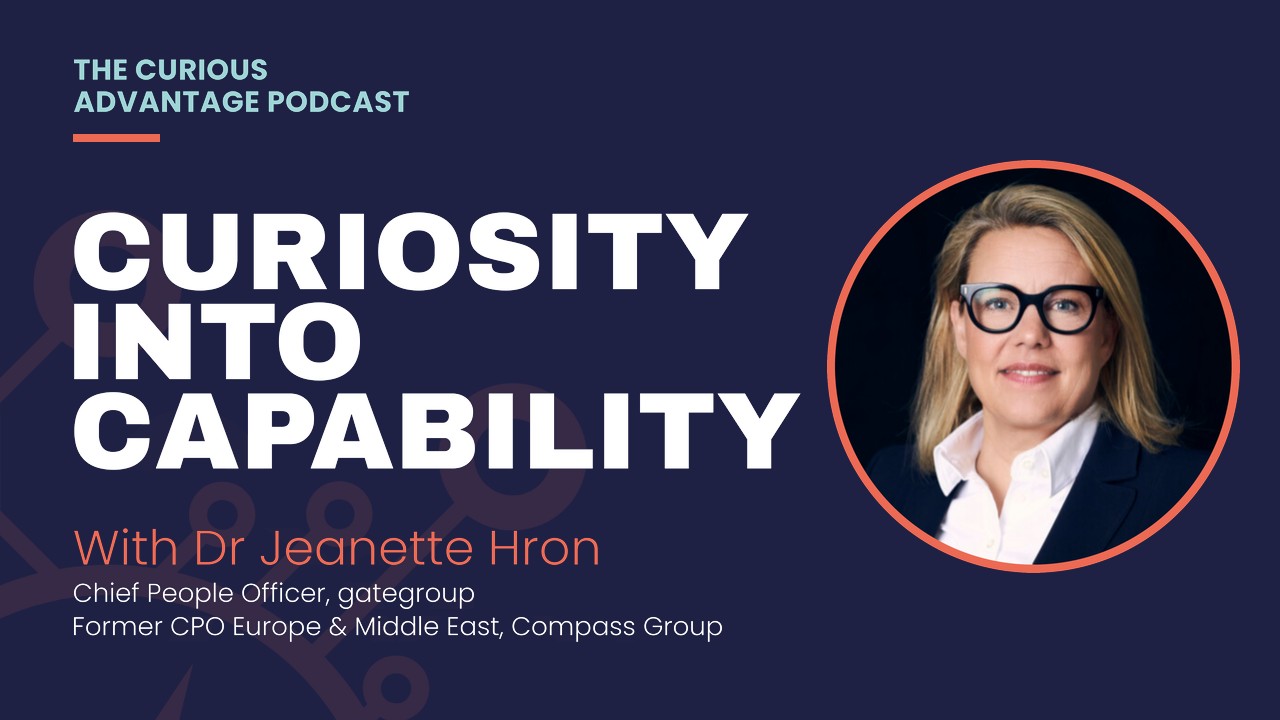
Dr Jeanette Hron: Curiosity into Capability (Chief People Officer, gategroup)



Transcript
Simon BrownHello, and a warm welcome to this episode of The Curious Advantage podcast. My name is Simon Brown, and today I'm here with my co-author Garrick Jones. No Paul today, I'm afraid, but we are joined by Dr Jeanette Hron. Jeanette is the Chief People Officer at gategroup. She joined in October 2022, having previously served as Chief People Officer for Europe and the Middle East at Compass Group. She brings more than two decades of executive leadership experience across several sectors, including roles with Munich Re, Novartis, Sandoz and Danone. At gategroup, Jeanette champions the company's values of excellence, responsibility, passion and respect, and she serves as an ambassador for diversity, equity and inclusion. She studied psychology in Switzerland and went on to earn a PhD in organisational psychology from Ludwig Maximilian University of Munich. Her career has also given her the opportunity to live and work across Germany, France and Switzerland. So, a warm welcome, Jeanette, to The Curious Advantage podcast.
Jeanette HronThank you so much for the warm welcome and for the introduction. It's my pleasure to be here.
Simon BrownIt's great to have you with us, and I'm looking forward to today's conversation. Let's start where we normally do — with curiosity. How do you personally define curiosity, and could you share a little of the role it's played in your life and career so far?
Jeanette HronAbsolutely. I believe curiosity is a state of mind which expresses itself in asking questions, exploring, and trying to understand different perspectives. I was actually thinking about this word in German. The translation would be Neugier, which is really a craving for novelty if you translate it directly — a craving for new information and new experiences. It has played an important role in my life and in my career. I was lucky to work in different industries and different global organisations across geographies, and to meet many different people. So, really in a discovery mode, if you want, throughout my career. Curiosity starts with the individual, and it drives this willingness, this craving, for novelty and exploration.
Simon BrownFantastic. Let's start with where you are at the moment — gategroup. I've seen the gategroup brand in many airports as I travel around the world. It's a fast-moving, highly complex global industry. For listeners who may know your work through their own travel experiences without realising it, can you share what gategroup does and what makes the business distinctive?
Jeanette HronYes. Our sweet spot is really enhancing the travel experience for people on the move through culinary delights. Our core business is airline catering. We operate in more than 60 countries across the globe, serving many global customers and also smaller airlines. We also offer catering for trains. So really, people on the move — in the train, in the lounge, in the aeroplane — would be our esteemed guests.
Garrick JonesI would imagine that, given the amount of travel both Simon and I have done, you've fed us on a regular occasion over the years.
Simon BrownMaybe I should attribute a kilo of my weight to gategroup.
Jeanette HronOur pleasure. We hope you're happy customers of ours.
Garrick JonesNothing bad to report just yet. I'm always amazed at how you create a small world on a tiny tray in front of you when you're sitting on an aeroplane. We laugh about getting a full English breakfast in a cup. I was equally intrigued by your use of the German idea of curiosity, which is really fascinating. You've described curiosity as an important element of your leadership, particularly because openness to new ideas often starts with the individual. So what do you believe curiosity looks like in practice for a leader?
Jeanette HronLeaders, in my perception, play a very important role in fostering an atmosphere of curiosity in an organisation. That starts with modelling good behaviour yourself: asking open questions, being interested in new ideas, and engaging with colleagues and team members in a way that embraces what they bring to the table. This is also where you can shape the culture of an organisation. Leaders who have a tendency to shut down open questions or to shut down ideas will never really get the best out of their teams, in my experience. I also thought about the notion of innovation in that context. Every business and every company needs innovation. And where does innovation come from? Innovation is not the leader's best idea, or the leader's ability to generate ideas. Innovation often happens when the leader is capable of listening to the team and to colleagues, and then picking up what they bring to the table. In that sense, curiosity really is a competitive advantage, and it leads to an organisation which is capable of developing itself beyond the individual level.
Garrick JonesYou say curiosity is a competitive advantage, which we believe too — we think it's the greatest driver of value in the digital age. But I'm interested in going a little deeper with you on how curiosity can be fostered in the organisation. What are the key things that create a culture of curiosity, to your mind?
Jeanette HronIt is the ability of everyone — including leaders, who of course often have a prominent role in this — to ask open questions, to be open to the ideas of other people, and to genuinely make an effort to embrace diverse perspectives. If you have that mindset in an organisation, with the leaders but also with the people in the teams, you have a fair chance that curiosity can become an element of the culture. I was listening to your introduction and to you mentioning our values at gategroup, and I almost thought we should add curiosity as a fifth value to our set. It really is playing an important role. In the end, everybody individually is challenged to think about: what is my level of openness, of willingness to change, of changeability? How do I show up in conversations? And leaders can give clarity and direction regardless, all while being open. Curious leaders create curious organisations.
Simon BrownI love that. And it was through curiosity that we first met, when I got to share some thoughts on curiosity with some of your colleagues. You mentioned role modelling — it was fantastic to see your CEO in the front row, absorbing it and talking about curiosity afterwards as well. So you have that very strong leadership around curiosity from the top. Why is curiosity so important to you, and why might it be a fifth element in your values?
Jeanette HronWell, I believe in the learning organisation. One of my core beliefs is that what got us here will not get us there. This is probably true for any kind of business and any kind of organisation. The moment you believe you are there, there's a risk that you become complacent — that you are not attentive to what needs to be the next step in the evolution. This is why curiosity is so important to me. I can see it play an important role for the organisation overall, but also on an individual level. And finally, curiosity is where growth begins. Curiosity as a condition for individual learning ultimately fosters the curiosity and the learning ability of the organisation.
Simon BrownI know that at gategroup you're really fostering and investing in learning and development, and you have your new construct of the Gate Academy. Can you tell us more about what's behind the Academy — how it helps build curiosity, and how it supports that culture of continuous improvement, that learning organisation you described?
Jeanette HronYes, it's a great question, and I love to answer it because it's really the new thing in our organisation. We were actually not creating that many new things. It was more about reflecting on our strategy and our business plan going forward, and really thinking about how we can formalise learning more. This is where the Gate Academy comes in. We have tremendous expertise in the organisation — throughout the different teams, our functions, our global entities and the different countries. What we did is bring all of the existing offers together under one roof. That's what the Gate Academy is about: creating transparency around the offer, so that people who are looking for development opportunities can find those offers easily and really contribute to their own learning. After many years in HR roles, I don't believe in the top-down assignment of learning. I think this needs to be driven by the individual. But in order for individual curiosity to meet the offer — or for the offer to meet the individual curiosity — you need a platform. And this is what the Gate Academy provides. It turns curiosity into capability.
Simon BrownCuriosity into capability — I like that. What have you been able to do to get people aware of the Academy? How have people reacted to it and to the investment you're making? What's been your launch plan?
Jeanette HronI believe we do have some curiosity in the organisation, fortunately, because the reactions were overwhelmingly positive. People were delighted to have this platform, and grateful that we offer learning opportunities in a more structured way that helps them navigate the offer. And it is just the beginning. In our mind, the Gate Academy covers all the different learning offers we have — from functional training to leadership training, self-directed learning and classroom training. It's really the platform to access all of it. There was a lot of interest and a lot of overwhelmingly positive feedback, so we could also see that people like to learn, and that they see it as an important investment in a world which keeps changing.
Garrick JonesIt's interesting for me, because if I think through the chain of gategroup — if I think, as a customer, how that food gets to me in the seat — it will have gone through an enormous number of engineering chains. It will have gone through a supply chain: raw materials, people cooking in factories, everything being packaged up. Everything has to be secure and hygienic. And then you've got all the distribution to the various outlets. It's an unbelievably complex supply chain, and you've got people at all levels within it. Are you offering the Gate Academy to everybody, and how do you take it out into the supply chain?
Jeanette HronOf course, the Gate Academy needs to be an offer for everybody. A learning organisation needs to take everybody with it. It cannot be a selected offer for some people that leaves others out — that is not at all the idea. As you usually have a mix in an organisation between practical learning, relationship-based learning and classroom training, we need to combine the offer we have in the Gate Academy — which is the more formalised offer — with traditional learning on the shop floor and apprenticeship-type models, which will not all be structured. As you say, our operations are huge and complex. What we try to do is enable leaders at every level of the organisation to work with their teams so they have the competence to deliver what needs to be delivered. The idea is not to fly people around, or to create artificial spaces where people learn. It's about tying it back to the workplace in the end. We also have a lot of train-the-trainer formats, so that we work actively with the people and the expertise we already have in the organisation, and the knowledge and the training can ultimately be available everywhere.
Garrick JonesThat's amazing. I'm also interested in how you talk about people taking ownership of their own development. How are you enabling people to take that ownership and become a learning organisation?
Jeanette HronAgain, this is where leaders come in. When they receive requests from people asking for training or learning of a special kind, they would be expected to listen and to find out what it is, and how they can support their team member to develop. It's about having the offer, it's about having transparency on the offer, and it's about the people function supporting it. There are many instances throughout the organisation and throughout daily operations where we have an opportunity to react positively to people reaching out because they want to increase their knowledge and their skills, and they want to learn. This is where individual curiosity needs to meet the curiosity and openness of the organisation. So we are actively working with our leaders so that they have this mindset — it is part of our leadership framework as well. I think it's really about stepping up to our commitment and just doing it.
Simon BrownAs part of becoming that learning organisation — that constant evolution, constant change, becoming future-ready — that involves innovation, AI, automation, and the continuous development of your people. What does "future-ready" mean in the context of gategroup? What does it look like to be ready for the future in your industry, and for the tens of thousands of people around the world doing this work every day?
Jeanette HronCuriosity needs to be an ongoing practice, which then leads to an understanding of what the challenges of the future will be. For me, the company strategy and the people strategy need to make sure we are ready to deliver the best possible services and products today and in the future. That necessarily includes an understanding of what the future will bring. Of course, some people are maybe more exposed than others, but my expectation would be for everybody to have that openness. As I said before: what got us here will not get us there. So we need to understand what the technical development looks like. We need to understand how this will change organisations and how it will change the work. I believe that curiosity also helps to overcome the anxiety and resistance that is often linked to new technical evolution. In that sense, future readiness for me means that you are knowledgeable about what is happening, that you anticipate what it may mean for yourself, your team and the business, and that you try to focus on those elements which will help us be ready to embrace these changes.
Garrick JonesJeanette, it's very impressive listening to you talk, because you're very clear not only about how you've structured the Academy and what you're trying to achieve with your people, but about how you communicate that. For example, you said things like curious leaders create curious organisations, and what got us here will not get us there, and curiosity is where growth begins, and turning curiosity into capability. These are very memorable. Do you have other memorable sentences that you use?
Jeanette HronI think you were very much focusing on leadership as one element of fostering a curious organisation. When thinking about curiosity, I also felt that it ties to many elements we have always stressed in terms of leadership development. We all heard throughout our careers: leave your comfort zone. Which translates into — don't stick to established recipes, try to find new ways of doing things, expose yourself, be courageous as well. That's of course part of it. And also how we assess the potential of people towards future roles and future contributions, which includes elements like dealing with ambiguity as one core factor. All of that is so closely linked to curiosity. So if we are able to really take up these good practices which we developed over many years — to stick to these elements of leadership development — I think we have a good chance to meet all these requirements you mentioned before.
Simon BrownWe've heard that from previous guests looking at some of the science around curiosity: that if you're curious, it stops — or at least reduces — some of the fear of change. Shifting into more of a curious mindset can remove some of that anxiety. So that certainly backs up exactly what you're describing. Talking about innovation — innovation isn't just about technology. It also leads to better products, better services, better experiences for customers. In bringing that constant learning and constant evolution to life, is there a particular project or example where you've seen curiosity, or that constant innovation, bring benefits for your customers at gategroup?
Jeanette HronWell, it's definitely very interesting to watch the new concepts around mobility. I don't know if or when this will be part of our scope as well, but there's so much going on. Flying taxis, hyperloops — I don't know if those will ever need catering. But there are a lot of new elements in the mobility space, where people change their travel habits, or where it becomes more normal to commute between countries. Just things like that. So this is definitely one area. Even the way we take planes is changing, so it's something we are watching closely. How do people like to travel? What are their preferences? And then, very interestingly, changes in nutrition and in food preferences — towards healthy food, more local, more regional food. So there's a lot out there which is interesting to watch, and lots of learning if you're curious.
Garrick JonesIt does amaze me that the day before I fly, the airline can ask me what meal I would like, if I have any special meal preferences. That's less than twenty-four hours. And then, if I'm on a diet, it'll be brought to my seat while I fly, which is amazing. The level of logistics and engineering is incredible. I wanted to ask you about all of this innovation you're watching in the background — the idea of watching the changes and the trends so you can respond, not only nutritional trends but also technological and mobility trends. Are you using AI? What's your view on AI and how it's having an impact? Is it scaling across your organisation, are you using it in specific places — what's happening?
Jeanette HronThe honest answer is that, like many other organisations, we are of course looking at it. We are assessing use cases. We are trying to get our heads around this new innovation. What seems very important to me is that we take the people with us. I've often heard, over the last period — for example when talking with chief HR officers from other companies — that we need to understand that AI is enhancing our ways of working. It is not replacing the work. Understanding this change seems a very important challenge to us. And we are discussing this, of course. But in my mind, this will be a journey over some time, because the technology is also rapidly evolving. It's a perfect use case, probably, for everything we've discussed in this podcast so far: a fast change of a complex nature, which really requires learning from all involved in order to see what the best way to use it going forward is.
Simon BrownI'm curious myself. Garrick was referencing the complexity of the supply chain and the way it's flexible enough that I can choose, the day before, that I want a healthy meal — and that's what I end up getting at my seat. What do you think people would be surprised to learn about that whole process? Whether that's what the people do, the complexity of it, or the innovation that's there. What's something we could all learn that we wouldn't expect?
Jeanette HronI think it is close to the way you asked the question — the enormous complexity, and the speed and agility we need to have as an organisation. I spend time regularly in our sites, and I'm always amazed about the ability to handle a lot of different items and different recipes. So the logistics of the business are actually quite impressive, that is true.
Simon BrownWe had Javier, the COO from Heathrow, on the other day, and he was talking about when they had to shut down the airport because of the power outage. He talked about the four hundred or so organisations that were rallying around. I'm guessing there were a lot of people there saying, "right, these meals no longer need to go there, we need different ones there." That agility must be incredible — to be able to shift, and somehow people still end up with the meals they want, because of all of those processes you have.
Garrick JonesTo follow on from what Simon's saying — I'm fascinated by the complexity as well. What would you say is the secret sauce? What's the most important thing that enables you to be so complex and so agile?
Jeanette HronI believe it's actually not so different from other industries and other organisations. It's a matter of clarity of the strategy, and clarity of the structures and processes. I don't think we have any specific recipe from that perspective. What is important, I believe, is that you always enable a good level of collaboration and cross-functional interaction in an organisation. Organisational fitness — or the ability to deliver whatever your business is — depends on the interfaces and how you manage them. When you have an organisation working in silos, or an organisation which has little internal fluidity, it's of course much more difficult. I spent a lot of my career working in organisational design and organisational development, and I believe it's a great topic in the context of our conversation about curiosity today. The ability to work together across boundaries, across functions and across geographies again requires openness, and this type of internal customer orientation which we also like to see externally. It starts with understanding what the other person really needs. And that ties back again to curiosity to some extent, because at the beginning of the chain you have that question: what is important to you, how can I help you today? If you have that spirit, I believe it helps a lot. And I believe we do have that spirit, because in an organisation which is anchored in hospitality and in the service industry, you find that type of attitude much more often than in other industries where customer orientation and service orientation do not play such an important role.
Garrick JonesI'm curious about the culture within gategroup. Given it's so complex and you're so agile, does it feel frenetic and chaotic, or does it feel calm? What does it feel like?
Jeanette HronI'm actually wondering, because you repeated a couple of times that we are so complex, with such a complex supply chain — and this is not how it feels to me. I would rather say it feels calm, because we do have this type of collaboration. It's a business which works well. And this is also where maybe the learning, or the competence-based approach, comes in again. I believe that whatever the size of a business and whatever its complexity, if you feel you have the capability to manage it, it probably feels calm — because then you are on top of it. If you ever are completely on top of it. But in order to get there, and in order to make sure that you master whatever you need to do, you need to have the competence and the capabilities. And that's maybe a nice link back to what we discussed before, with our Academy and the need for an organisation to foster learning and continuous development.
Simon BrownI'd like to come back to that. You've been hugely successful in getting the support and the investment to create the Academy and deliver those capabilities. For anyone listening who's thinking, "I would love for our organisation to have an academy like that, and to be prioritising learning and curiosity, and the investment in it" — is there anything about the process you followed, any tips, anything about the case you were able to make?
Jeanette HronWhen you talk about training, it often helps to start with a good analysis of what the needs really are. And that counts for individual learning as much as for organisational learning: to understand where am I today, what is the requirement for the future, and how do I get there. That would be the one general piece of advice I would give — that it's important to understand this journey from where you are today to where you want to be in the future.
Simon BrownLet's come to you personally. Beyond your current work, what are you curious about at the moment?
Jeanette HronMy personal curiosity is, fortunately, satisfied a lot through the work I do. Working in a global organisation and meeting so many different people every day is just a wonderful thing to have when you are curious. So that is definitely one element which I enjoy a lot. I also enjoy discovering different perspectives. I like to read a lot, including fiction. It helps me not only to see different perspectives, which I find intriguing in itself, but also to get my head around what might be the next steps on our journey. The ideas you find from other people give you a good idea of what's out there, and what will eventually shape our future. I enjoy these things a lot because I'm of course very curious about how everything will continue — how we will live in ten years from now, how we will live in twenty years from now. Which should then be an important input for what I need to learn, and how I can possibly support the organisation I work in.
Garrick JonesJeanette, is there a question you think everybody should be asking today?
Jeanette HronI think the question everybody should ask is: how can I make a contribution, and how can I challenge myself to make that contribution? That is one question coming to my mind.
Garrick JonesAnd by contribution, do you mean to society? Do you mean to their local community? Can we explore that a little more?
Jeanette HronYes, I believe on different levels. I'm quite an optimistic person, and my basic understanding is that people want to do well. It feels good to have a positive impact on your environment. And how do you create this? If everybody tried to do their best and give their best and keep learning, I believe we would live in a wonderful world. So you can try to do some of that every day.
Simon BrownIt would be great if we had more people asking that question, definitely. In a moment I'm going to come to you, Jeanette, for the one thing you could leave our listeners with. But before that, I'm going to try to wrap up a very broad conversation. We started with your thoughts on curiosity — how it's a state of mind, how it starts with exploring. We heard how it links to the German word Neugier, around a craving for new information, and the important role it's played in your career across different organisations, industries and geographies. We heard about what gategroup does: 60 countries, airline catering, trains, lounges — and a lot about the complexity that sits behind that. Then how important curiosity is for leaders within your organisation, creating that role modelling of good behaviour, thinking about curiosity in terms of open questions and new ideas, engaging with people and creating an environment where people can bring things to the table and really innovate — and the importance of listening and picking up what people are saying. And that it might almost be a fifth value in your cultural values. We heard some great phrases, like having the platform to turn curiosity into capability — your Gate Academy — and the great work you've done to get support for that, and the investment you're making to bring all of those different learning offers around the world together under one roof, one platform. How people have been delighted with it and had that overwhelmingly positive reaction, how people like to learn, and how with the changing world that's becoming more and more important. We heard how the Gate Academy is for everyone. We moved to innovation and things like mobility and where things might be going, and particularly the move towards nutrition and local produce. We touched on AI and some of the ways we need to be thinking about and understanding that. And then your suggestions for people who want to set up their own academy: look to the future, start from the needs analysis, work out what that future looks like and how to get there — and that journey then creates the case for creating something along the lines of an academy like yours. Then we heard about your own personal curiosity, how you read a lot of fiction and the ideas that gives you, and other people's views on the future. And that super important question: how can people create a positive impact on the world? So if there was one thing from all of that to leave our audience with, what would it be?
Jeanette HronDifficult to summarise all of that in one word.
Simon BrownIt's a lot, absolutely.
Garrick JonesJeanette, do you want to think about it a little more while I respond to something Simon said? One of the things I value so much about this conversation, Jeanette, is your ability to create memorable phrases. I made a list of them as we were going through, just to add to Simon's always great synopsis. You said: curious leaders create curious organisations. And: what got us here will not get us there. And: curiosity is where growth begins — another great one. Turning curiosity into capability. And: individual curiosity needs to meet the curiosity of the organisation. They're all so great. You talked about complexity, and that clarity is needed for complexity. That collaboration is needed for complexity. And that curiosity overcomes anxiety. Leave your comfort zone, be courageous, and deal with ambiguity — all of which need curiosity.
Jeanette HronYes, any of those could be a closing remark, by the way. And it's all connected. I really believe it's all connected. Linking the individual level to the organisational level is exactly what makes organisations successful — in both ways, by the way. We need to take all our people with us if we want to be successful in the marketplace in the future. At the same time, everybody, through their own learning, can contribute to the success and to the learning of the organisation. And this is what makes working in the people function so rich, because you have all these levels: of the individual, of the team, of the organisation, and finally of the business. For me, to be honest, our conversation today — and also the thoughts which went into it in preparation — really make me believe that curiosity is one core element in creating that connection between those different elements in an organisation. And it is not to be underestimated. Other elements then come in as well: the ability to create clarity, the courage you need to try out new things. But the starting point, and the trigger to set this in motion, is the initial curiosity.
Simon BrownThat's a great one for us. So, a question: how can people link together that individual to the organisation, and make that connection so that everything joins up? Fantastic. Thanks so much for joining us, Jeanette.
Jeanette HronThank you so much.
Garrick JonesThank you, Jeanette.
Simon BrownYou've been listening to The Curious Advantage podcast. What are you curious about after this conversation? Do share on whichever social channels you have, leave us a review on Apple Podcasts, rate us and follow us on Spotify, or join the conversation with us on LinkedIn. We'd love to hear what resonated, what surprised you, what made you think differently — and maybe how you're going to link that individual through to the organisation in your own situation. Our new book, The Curious Imperative: Why Questions Beat Answers in the Age of AI, will be coming this autumn, exploring why curiosity matters more than ever in our rapidly changing world. So subscribe, stay curious, and we'll see you next time. Thanks for joining us.
Every time you eat on a plane, you are at the end of one of the most complex supply chains in the world. Dr Jeanette Hron runs people strategy for the company behind a huge share of it.
As Chief People Officer at gategroup — airline and rail catering across more than 60 countries — Jeanette joins Garrick Jones and Simon Brown to talk about what it takes to keep an organisation of that scale learning. She makes the case that curiosity is not a soft value but a competitive advantage: innovation, she argues, is rarely the leader's best idea, it is what the leader is curious enough to hear from the team.
The conversation centres on the Gate Academy, gategroup's new learning platform, built by bringing scattered expertise under one roof rather than inventing something new. Jeanette explains why she stopped believing in top-down training assignments, how the Academy reaches people on the shop floor as well as in the office, and what she tells leaders who want to build something similar.
In this episode:
- Neugier — why the German word for curiosity, a craving for novelty, says it better than the English
- Curious leaders create curious organisations, and why innovation is rarely the leader's own idea
- Inside the Gate Academy: scattered expertise under one roof, turning curiosity into capability
- Why top-down learning does not work, and how the offer reaches the shop floor
- What got us here will not get us there: future readiness, and curiosity as the cure for anxiety about AI
- Why an operation this complex should feel calm rather than frenetic
- The question Jeanette thinks everyone should be asking
Listen and subscribe