

Episode 109 · Oct 21, 2026
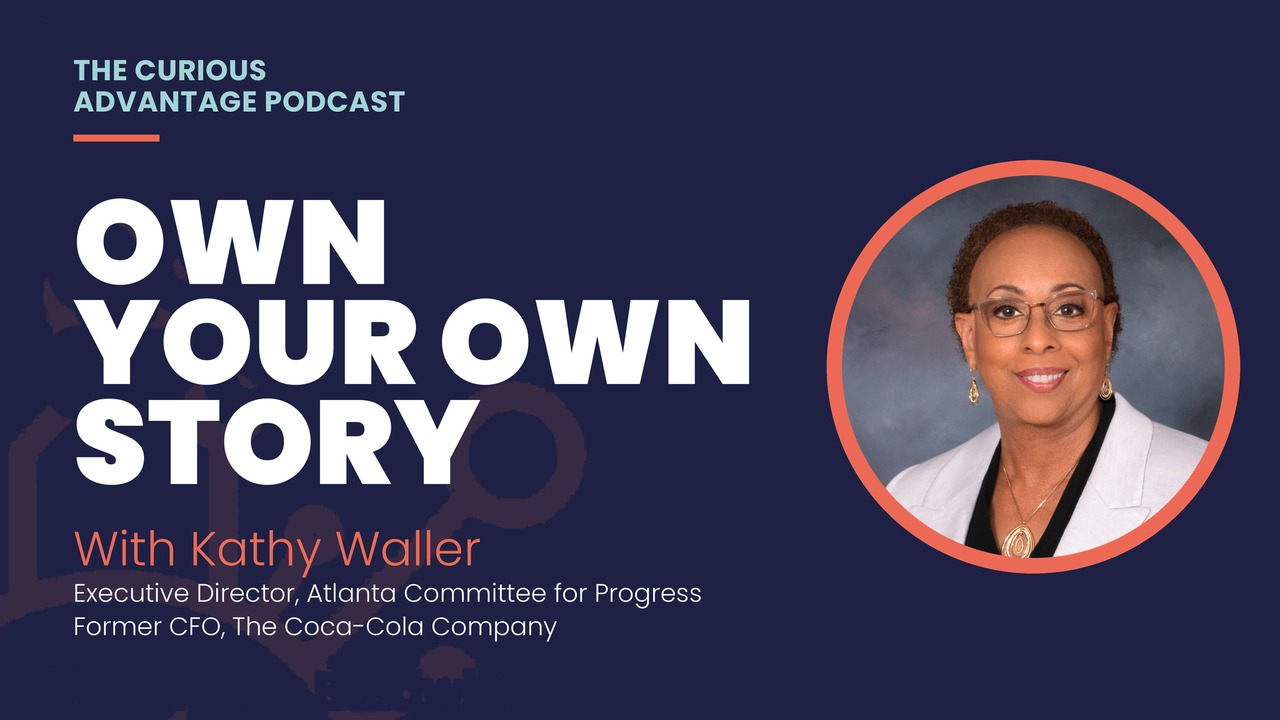
Kathy Waller: Own Your Own Story (Former CFO, The Coca-Cola Company)



Transcript
Garrick JonesHello and welcome to this episode of The Curious Advantage podcast. My name is Garrick Jones, and today I'm here with my co-author Paul Ashcroft.
Paul AshcroftHi there.
Garrick JonesToday we're joined by Kathy Waller, a highly respected business leader, board director and community advocate with more than 40 years of leadership experience. She currently serves as Executive Director of the Atlanta Committee for Progress, an organisation that brings together business, education and civic leaders to help drive economic growth and opportunity across the city of Atlanta. But before that, Kathy spent 32 years with The Coca-Cola Company, joining as a senior accountant in 1987 and rising through the organisation to become Chief Financial Officer and President of Enabling Services. In those roles she led Coca-Cola's global finance and shared services organisations, and represented one of the world's most iconic brands to investors and stakeholders around the world. Alongside her executive career, Kathy was the founding chair of Coca-Cola's Women's Leadership Council, helping to advance opportunities for women across the organisation. Today she serves on the boards of Delta Air Lines, CGI and Beyond Meat, and is actively involved with several educational, cultural and community organisations, including Spelman College, the University of Rochester, United Way of Greater Atlanta and the Atlanta History Center. Welcome to The Curious Advantage podcast, Kathy.
Kathy WallerThank you. Nice to be with you today.
Garrick JonesIt's so great to see you again. We're fascinated by your career, by everything you've achieved and everything you've learned through all of that, and also by what you're doing today. And of course, the focus for us is curiosity. I know you have an opinion, but let's start where we always do. How do you personally define curiosity, and what role has it played in your life and career over the years?
Kathy WallerCuriosity has always been an important skill for me, because it allows me to ask questions and learn — and I love the idea of being able to learn something new. When people know that by nature you're curious, they don't mind your questions. They kind of tolerate all of your constant questions. The other thing is, I started my career with curiosity, being an auditor, because that was my job: to go and ask questions. And I found that I absolutely loved it, because it allowed me to go to different types of businesses, learn about them, learn about the people, how they got to that particular job. In my earlier years I was always exploring — is that something I could see myself doing? So the fact that I was able to, for a living, just go and talk to people and get to know them and meet them, was fantastic. Curiosity has always been a part of who I am, and a part of what I did at work, frankly.
Garrick JonesWould you say — I mean, you joined Coca-Cola as an auditor and you went on to become CFO…
Kathy WallerActually, I didn't join Coke as an auditor. I was an auditor at Deloitte before I joined Coca-Cola. I spent four years as a public accountant, going from business to business, learning about their businesses and reviewing their financial statements. And part of it, I did tax work. So I worked for a lot of different companies, including banks, and learned how to audit different types of industries. That was before Coke. And then when I joined Coke, I joined as a senior accountant in the accounting research department, where again my job was to make sure I was asking the right questions on the divestitures and as we were purchasing acquisitions. And then I started working with the CFO and pulling together his board presentations to present to the board. So when a quarter would close, I would have to go and find out from various people how to explain that quarter so that he could explain it to the board.
Garrick JonesAuditing and accounting sometimes gets a bad rap — it can be considered very serious. And yet we've spoken to a number of people on the podcast recently who started off as the accountants or the financial officers and went on to lead these great companies at the highest levels.
Kathy WallerIt absolutely can.
Garrick JonesYou talked about your auditing experience going to many, many different companies. How did curiosity play into auditing, and what you learned as your career took you into senior leadership?
Kathy WallerSo the first question is always a question that you need in order to answer something very specific for your job. But the next question allows you to delve deeper and to get behind what's really going on. Whether it was for my role as an auditor, or my role when I joined Coke — preparing financial statements and the explanations for those financial statements — for me it was always about, well, okay, can I dig a little bit deeper to understand what drove what was going on in the business? People want to give you the explanation of "sales were up because our marketing programmes worked really well." Why did the marketing programmes work so well? That's great — so what was it about this particular programme that made it work so well? That's the kind of thing my CFO at the time needed to explain to the board, because they would ask questions about what you are doing next time. "We're looking at a business plan for you — what's going to drive the sales for the next year?" So those questions allowed me to dig a little bit deeper. My job allowed me to continue to ask the question, to ask "why", to ask "how would you do that differently", to ask "what did you learn from it".
Paul AshcroftKathy, you were at Coca-Cola for more than 30 years. You had an incredible career there, and Coca-Cola, it goes without saying, is a globally recognised, fantastic, iconic brand.
Kathy WallerYes.
Paul AshcroftHow does Coca-Cola stay relevant? How does it adapt, and how have you seen it stay relevant over these years of changes in markets, technology, consumer behaviour and so on? What's the secret sauce behind its resilience?
Kathy WallerWell, when you follow the consumer, you stay relevant. If you are giving the consumer what the consumer wants, you are always aligned with them, and that alignment allows you to stay relevant. That alignment, plus obviously caring about things like the taste and making sure that the taste profile works in each of the regions that we work in. And making sure that our advertising — we were always the advertisers that touched the heartstrings, so that we connected family, good times and positivity with the company and with the individuals. Which worked, because even when things are not going well, you want to have some level of optimism and positivity, and our commercials, our advertising, helped connect the potential for positivity and good times with whatever was going on at the moment. So bringing family together and friends together to celebrate positive moments, even when things around you weren't great.
Garrick JonesYou're the founding chair of Coca-Cola's Women's Leadership Council. That must have been a journey. Can you tell us a little bit about that and what changed as a result?
Kathy WallerI am. Very proud of that. Well, when we first started, we defined senior leadership as director level and above, and our senior leaders wanted to make sure we had a pipeline of women ready for senior leadership. They pulled together fifteen women from around the world to come up with the plan that would allow the company to always have that pipeline. One of the things that we did, working with the human resources group, was create a programme called Women in Leadership. It was designed to create that pipeline, and it was designed to identify women who not necessarily knew they wanted senior leadership, but could explore the idea of senior leadership and decide if they wanted senior leadership — because it's not for everybody, because of various circumstances that you have. And so we would bring women into, usually, Atlanta, and they would spend a week focusing on themselves, which women don't generally do. They focus on the family. They focus on everybody else's needs before their own. So they spent a week actually focused on: what was it that made them happy? What was it that they were interested in doing? What were they curious about learning? They took that time, and we gave them opportunities to have a coach. We gave them opportunities to try things that they hadn't. If they were marketing people, we taught them a little bit more about finance. If they were finance people, we let them explore operations or marketing. And during that week's time — but mostly we let them think, and they thought about what it was that they wanted to go and do. That ended up being like a secret weapon, because not only were we trying, from the top down, to develop women and get them into this pipeline — when they decided that that was something that they wanted, they would go back to their markets and demand something different in their careers, which was outstanding. So between those two pieces, we were able to get a great pipeline for the company, and that pipeline has been going on for several years now.
Paul AshcroftKathy, as a very senior female leader yourself, and with a career of advising other organisations about that, as you think about women at all levels of their career — what would be some of the advice that you would give them if they're asking you questions about how to get on next, how to get to the next level, whether it's starting that first rung or moving up from being a manager to senior manager, to director, to indeed becoming an executive and even chair? What's the advice you give?
Kathy WallerMy advice would be, first, understanding your organisation: how do things get decided, how do decisions get made. Coca-Cola was very relationship-oriented, and you find a lot of organisations are very relationship-oriented. If that is the case, key relationships matter a lot. So you need to make sure that you're always developing those relationships. You have not only relationships with your line of succession, of hierarchy, but with other parts of the business as well. And you need to make sure that you're having those conversations, that they know who you are. It's very important for people to get a comfort level with people, particularly at a place like Coca-Cola. And to do that, you need to be a little bit vulnerable and help them understand who you are, what you want out of your career, what success would look like for you. And then in turn, they also need to help you understand: "I understand how you're looking at this, but let me tell you what the possibilities are." Because you've been working and you've been focused on your job — you have no way of knowing what the possibilities are at the company. And so this is an opportunity for you to explore that there are lots of ways to get where you ultimately want to go. So let's figure out what's the right path for you, and how you get there.
Garrick JonesDoes that extend, Kathy, into diversity — people from different cultures, backgrounds and disciplines? And what's been the value of leading a global team and having all those different cultures present?
Kathy WallerThe value, frankly, has been twofold. Part of the value is that for the company, you got the benefit of different experiences and different ideas and thoughts that helped you in your particular market. The other value was that you really got a global view. You were able to see the world very differently. Before I joined Coca-Cola, the furthest I had ever been was Canada, right? I was in Montreal. And then after I joined Coke and I started travelling the world, I never knew I wanted to travel the world until after I joined a company where the world was the opportunity. And once I realised the value of travelling the world, I ended up having friends all over the world, and I ended up having experiences all over the world. So now, as the years have continued, I continue travelling, because the value of seeing and experiencing other things became really important to me. I may never have experienced that enough to know that I really wanted to do that in a big way until I joined The Coca-Cola Company.
Garrick JonesCan I ask, where is one of your favourite places to go these days?
Kathy WallerIstanbul. It has always been one of my favourites. I was a history major in college, in undergraduate school. And when I went to Istanbul — initially the first time I was there for about three weeks, and I got a chance to truly explore it. It was so rich in history. I would leave the office at five or six and then I would just spend the rest of the night exploring, because they just had so much to offer. And the food was great. The people were great. It was, frankly, an experience that I loved and redid every opportunity I got.
Paul AshcroftIn your portfolio of careers that you manage, you've now, as I understand, moved from leadership into also governance and board governance. So you serve organisations across aviation, technology, food innovation, education, non-profit. That's quite a broad church of interests. What's changed for you, and what have you learned as you've moved into governing and being part of the governance of these organisations, as opposed to just operating and leading them?
Kathy WallerWell, moving into governance has allowed me to get to know three different industries. So it has fuelled my curiosity and allowed me to explore and learn about three very different industries. The airline industry — actually, I started on the board of Delta when I was still CFO at Coca-Cola. It was more challenging at the time, having my own very, very demanding job as well as this board role. But it was so fascinating to learn how an airline runs. It is the most complex operation you can imagine. When you're just flying with them, they make it look so easy. You don't think about all the parts they need to have on hand, because of all the different planes that they have, the types of planes that they have. You don't think about what happens when a plane goes out of service and they have to pull a different plane into service, and if it's not configured the same way, how do they have to reconfigure the passengers to be able to get them on the flight, and how quickly they need to try to do that so that they can get those passengers on their way. And what it means in various hubs to have inventory available or not. And if you have to get a part from Atlanta to Salt Lake, what that means. And you have to get a pilot from one place to the next. It's incredibly complex. And then the back-office part of that: there's a group of people that sit in Atlanta that know everything that happens every minute on every plane. They know if there's a plane flying to South America and there's an active volcano somewhere — they have to figure out that there's an active volcano and reroute that plane. I mean, it's amazing how complex that business is, and I find that absolutely fascinating. That they get that done day in, day out. I find that fascinating.
Garrick JonesCan I ask — you've had so much experience leading so many people at the top of these great, huge systems. Can you share with us some of your insights on how you get the best out of people, and how you manage this complexity?
Kathy WallerWell, managing the complexity means you've got a well-oiled operating system, with all the appropriate policies and procedures in place, because you can't function like that unless your policies and procedures are in place. And people are well trained for their jobs, they know their jobs incredibly well, and there's a level of trust that has to happen, because you have to trust that every piece of the operation is going to work when it needs to work. To build that trust, you have to make sure that both sides — the people trust you as much as you trust them. Which means that you've got to, especially for Delta, take care of your people. When your people know that when you say "people matter, people come first", they have to know you mean that. Which means you've got to let them make decisions. And with the support of the folks back in Atlanta — they're always calling back to see if they need to do something different — but you've got to trust the people on that plane to be able to make the right decision. So if a pilot is taxiing to take off and they have a passenger that is not cooperating, right, that pilot will come back. Or if the pilot feels that for any reason they need to come back, which will delay that plane, which will then interfere with your statistics of on-time take-off and arrival, et cetera — but that's the pilot's decision to make, and you trust them to make the right decision. You can only have that complexity every day in, day out, and have it managed, and have people do their jobs and do them the right way, if you trust them and they know you trust them.
Paul AshcroftIt seems to me you have a mode and a mindset of "pay it forward" — that you've clearly had a really successful career yourself, and you're now working to help others in their careers. I'd love to unpack some of the things you do to help with progress there in Atlanta. But I wanted to ask, I'm curious: do you have any mentors or other leaders that have inspired you over the years? Who do you look to and learn lessons from?
Kathy WallerI have been very fortunate that in every part of my life I have had mentors that have helped me navigate difficult situations. They have helped me to expand my thinking. They've introduced me to people that have also helped with my career. They've been amazing support. I start that with my actual sister, who was eight years older than I am. When I was still in high school, she was in college. And she was the reason why I actually left Atlanta and went to the University of Rochester in Rochester, New York — such a different environment. She said, "You need to grow up, so you cannot stay in Atlanta, you need to leave." And she was absolutely right. I needed the experience of being in a totally different, almost foreign environment. I mean, I was in an all-Black high school. My surroundings were totally Black. I left Atlanta and went to a school that at that time was less than five per cent Black, and survived in what I call a very difficult, very cold climate as well — and it was snow, et cetera — and an environment that was difficult from navigating it personally. And I was able to thrive. That level of confidence that that gives you allows you to challenge yourself and put yourself in other difficult situations later in life. But it also allows me to help people who are navigating difficult situations figure out — or at least understand — that you can navigate that difficult situation. It does not define you and you can get through it. And I did. So let's talk about how you get through it.
Paul AshcroftYeah. And tell us a bit about that, because we know you're, as many other things, Executive Director of the Atlanta Committee for Progress. Tell us a bit about that. What's its purpose, and what's it achieving?
Kathy WallerSo the Atlanta Committee for Progress has been in existence since 2003. It started with Mayor Shirley Franklin. She started it because — a consultant, when she took over as mayor, she walked into some very difficult things that were happening. She had budget issues and she had a major water infrastructure issue in Atlanta. And the consultant suggested that she gather the CEOs of the largest companies headquartered in Atlanta as kind of a cabinet, as kind of an advisory group. And that's how this group started. And it's been going ever since, and it has supported every mayor ever since. And mayors use it in different ways, because they have different challenges. I'll give you another example: a mayor — not the current mayor, an earlier mayor — had a challenge with figuring out the city's pension system. It was burdensome for the city and he needed to make a change. The CEO of Delta at that time, Richard Anderson, took on a task force to help him do that. So what it does is that it helps the mayor tackle the difficult problems, as an advisor. And today we are advising on things like homelessness, affordable housing. And the mayor has a programme, based upon his North Star, that he wants Atlanta to be the best place to raise a child. And today there are some challenges with that, particularly in underserved neighbourhoods. So he wants to reinvest in those neighbourhoods so that children have a better chance of success, because they live in an environment that's nurturing and helps them develop and get exposed to the right things.
Garrick JonesI'm amazed by that. It really strikes me when you have an objective which is: let's make Atlanta the best place to raise a child. I mean, that's amazing, because it's motivating, it's encouraging, it gets you to look to the future, but it also informs all of the decision-making that you make for all the small things.
Kathy WallerThat's right.
Garrick JonesHow did that…? I mean, that's just brilliant. How do you come up with something that clear and that clever?
Kathy WallerWell, our mayor — his name is Andre Dickens — he's a native of Atlanta and he has seen the tale of two cities in Atlanta. Atlanta is an amazing place because the leadership of Atlanta has allowed for the environment that we all live in, for a very positive environment in Atlanta. However, in Atlanta, unfortunately, if you are born in the wrong neighbourhood — and we call it by zip code — you have a four per cent chance of getting out of poverty. Today. That's right. And this mayor's decided that that's the end of that. We need to do something about that. And he's absolutely right. And there have been programmes all along to help develop children, and they're great — not-for-profit organisations, Big Brothers Big Sisters, lots of different ones, I can't call them all off right now, but the community foundations that are supporting people. This mayor decided we needed to do something comprehensive, not a quick fix, that would actually change a neighbourhood. There was a study done that said if a child could move six miles — just six miles — the exposure that that child would get to different things would change the trajectory of their life, and their lifespan, by 20 years. You can't move every child six miles. So the mayor decided we're going to change the environment they live in today. Which includes creating early childhood centres, so that by the time they get to kindergarten they have the basics they need to become great readers. That means creating affordable housing in these neighbourhoods, so that a child doesn't have to move frequently and change schools because their parents can no longer afford where they're living today and they have to find somewhere that they can afford — so the child then has to start all over. So those are the foundational things that we have to change. And then create green space, so that the child can be outside. And bring in other neighbours that are at a different level, right, so that a child has the opportunity to meet people in their own neighbourhood that can teach them things about the world, or just how to think differently about their opportunities in life. That's what we're trying to do. And he's trying to do it in seven neighbourhoods in Atlanta at the same time.
Garrick JonesThat's inspiring. It reminds me — in London we've had some really great success with youth groups. When youth groups are funded, whether they're sports-based or social-based youth groups, what you do is you provide places for kids to get out of their normal environments. The phrase they use is "pathways to value". They meet people, and people can nourish and encourage and allow them to see a way through. The other thing is, kids who come from privileged backgrounds are exposed to working environments and parents who may work, and what it means to go to an office, or even go to university and have a career and so on. And kids who do not…
Kathy WallerThat's right. It helps both.
Garrick Jones…they need to meet people like that so they can see it. You mentioned it earlier — all the opportunities that they might not see within their context. I think it's hugely powerful. And certainly in London it led to a direct decrease in young people joining gangs and things like that.
Kathy WallerYeah, it does. It does decrease the reason why people might want to join a gang — to feel a sense of belonging, and to see a way out of poverty, right, and see an opportunity. They don't need that any more. If you give them another reason, if you give them another opportunity to see their way out, if you give them something else to strive for, they don't need to join a gang or to commit a crime.
Garrick JonesIt takes resources and it takes people to volunteer and be involved. And that takes mobilising the community as well, which is also not easy.
Kathy WallerWell, Atlanta's a great community for that, because we have a history of that. One of my favourite stories — and it actually gets back to Coca-Cola — was Mr Woodruff, who ran Coca-Cola for many years. He was a formidable person and a very kind person. And when Martin Luther King Jr won the Nobel Peace Prize, it was during a time where the business community here was not rushing to celebrate him, if you will. There was a lot of racism. And Mr Woodruff said to that business community, "Look, you all need Coca-Cola more than Coca-Cola needs you. We are going to do the right thing in celebrating this man, and we're going to do this right." And they did. So Atlanta has that kind of history. Mr Woodruff's only one of them. There are many people in Atlanta's history that have done amazing things to push us, the city, to do the right thing. And it has become — we call it the Atlanta way — it's become a way of life in Atlanta. So that if I can go to any of the major corporations here and make the argument for what we're trying to do and get them to see the vision, they help with all of their resources. They not only help financially, they give us people to help. They step in and they get involved. Every last one of them. Delta being a leader in that, UPS being another one, Georgia Power — every last one of them steps up for Atlanta.
Paul AshcroftIt's fascinating, Kathy, and what I'm hearing from you is how, yes, in Atlanta you've got great leaders that are leading this change, you've got the community that gets behind these ideas, but also — and it seems like this is borrowed from perhaps yours and others' corporate experiences — how you are approaching these complex societal problems as a system and looking for a systemic solution or approach to getting things right. Not just "let's give this problem more money, let's build a new youth centre"; it's looking at all the different components. So I have a two-part question. One is: are you seeing this model successfully replicated elsewhere in the States or elsewhere? And secondly, is there an overlap in terms of what distinguishes those corporate organisations that continue to innovate and thrive, and those that struggle to adapt, essentially? Do you see similarities there?
Kathy WallerYes, we have seen this done in other places. It's called place-based change. There's an organisation in Atlanta called Purpose Built that works across the country, and there are other organisations outside of Purpose Built that focus on place-based changes. So where you make the change where you live, rather than trying to move you to a different place. And this has worked. We've visited places like Dallas and Houston where they've done things successfully. Now, the one we have in Atlanta is probably the biggest, trying to do seven neighbourhoods at the same time. But we know the model works. If you focus on it and you just systemically keep moving forward and knocking down barriers, we know it works. And so yes, I think the fact that some of the corporate organisations that we've seen that have lasted over time and that are successful — they figure out how to reinvent themselves, which is a lot of what we're doing here in Atlanta. You want to stay relevant, you have to periodically reinvent who you are, what you do, how you do it. Disrupt yourself before you can move on — or somebody else will come and disrupt you. So they have to do it for themselves. And that is what they are continually figuring out: how do I do it better? How do I make it more sustainable? How do I make it more lasting? That is what we're trying to do in the city. So I think there is a parallel, yes.
Garrick JonesWe love Atlanta, Paul and I, if I may say. We've worked there a number of times over the years, spent quite a bit of time in the city, spent quite a bit of time doing complex work where we needed to take a break and we'd walk around the parks and just walk under the trees, just to kind of get our stuff together. But it's a beautiful city to do that in, in the fall. And we also love the music. I mean, we stayed in places where you just come across people making music all the time, and the music tradition is astonishing. So we're great fans. I wanted to ask you what you're genuinely curious about, perhaps outside of your work, all the things that you've focused on.
Kathy WallerSo outside of my work, my job — one of the things is I do coaching with executive leadership groups, which I absolutely love, because it allows me to take all my learnings and my mistakes and help somebody else avoid them. I work for their clients; I've had some great clients in various places and around the country. And I do a lot of not-for-profit work. So what fuels my need for music is I'm part of the Woodruff Arts Center here in Atlanta — I'm actually currently the chair of the board of the Woodruff Arts Center. So that allows me to do symphony concerts, and to go to the High Museum, and to do the theatre at the Alliance Theatre, and we've had some great projects there. So I have a very rich and full life — my portfolio life, as I call it, and I love it. I'm actually currently the president of the Rotary Club of Atlanta. So I'm doing Rotary at the moment, and that's been another way of giving back to a wonderful organisation that supports people and supports growth here in Atlanta. So I'm kind of all in.
Paul AshcroftMakes sense. They say, if you want to get something done, give it to a busy person, Kathy. I guess you're that busy person people turn to. I have a question for you. You mentioned you've been thinking about the lessons that you've learned. As you look back over your career — and you seem like a reflective person to me — what would be the most important lesson you've learned that you wish you perhaps understood much earlier in your career, that you could share with others?
Kathy WallerSo the most important lesson, I think — I actually did learn it early — which was: meet people where they are. That has allowed me to accept difficult issues as an issue, not as a difficult person. Right? To see a person because of what they may have experienced that got them to the point where I'm having a conflict with them. Not as the fact that they are difficult to work with, or just a challenging individual — but we're all a collection of everything that we've grown up with and that we've experienced. And so I've met people that have had very little exposure to Black people, for instance, earlier in my life. And what they were exposed to, or did not understand, caused them to then have feelings that I'm now trying to help them with, or that I'm having to deal with, right? And so I stopped thinking of it as an issue with them personally, and dealt with the fact that they didn't know me. So that it helped me figure out: if I find this person to be somebody that I need to figure out how to work with, they've got to know who I am. They've got to understand that there's very little difference between the two of us. And when I can bridge that gap, then we have a basis for moving forward. Until I can bridge that gap, there's no basis for moving forward. So that was probably the best lesson I learned. And I learned that very early, when I was in a totally different environment in Rochester. And that is the lesson I help people understand, particularly when they're in challenging situations and they're having trouble navigating, because they're having trouble with a particular individual or group of individuals. That's probably been one of the best things that I have learned. And a mentor helped me learn that, in Rochester.
Garrick JonesThat's so helpful. Kathy, we're running out of time. I'm going to ask you to think about perhaps one thing to sum up everything you've said — one thing that you'd like to leave with our listeners. But while you do that, I'm going to try and summarise a little bit of what we've been talking about today. We started by talking about asking questions, and how the next question is really most important after the first question, because it allows you to dig deeper and get to what drives things, and how curiosity is really about the asking of the questions. We talked about following the consumer to stay relevant, for all organisations. We talked about promoting women, and how you created the systems to allow that to come through and create the legacy for women to be in the Coca-Cola organisation — but that expands way beyond the Coca-Cola organisation. We talked about understanding how you need to understand how decisions get made within the context, and to develop relationships, because that's how you get things done, especially in complex organisations — and being vulnerable to allow people to understand who you are, to enable you to bridge that gap. We talked about the value of diversity, and friends, and the value of experiencing the other, and travel, and what we can learn from that. We've talked about so much. It's about governance of very large organisations. You talked about the things you've learned from three different industries, all highly complex, and about managing complexity, and fundamentally about trust, and how trust-building is at the basis of taking care of people, and saying what you mean and meaning what you say, so that they trust you in order to get things done. A few more. You mentioned navigating and expanding our thinking by going into different situations, or challenging ourselves. You talked about your experience at Rochester, how that took you out of what you were used to, but gave you the platform for much that's come after, and enabled you to learn how to navigate difficult situations successfully. And we talked about Atlanta, which we all like. It really struck me that you are focusing on it becoming the best place to raise a child. I mean, that really rings with me. It's a beautiful motivation, because you can see how that impacts so many people. And then you talked about place-based change — making the change where people are — which is also very wise, and how the things you're involved in to make these changes happen in the community are being spread around in various other places. And part of that is staying relevant by disrupting yourself, and doing things better, and going back to basics, and meeting people where they are, and building the bridge between where they are and where you are in order to build that trust. It's such a fascinating conversation. It's so wonderful to spend time speaking with you. Thank you. And what would you leave our listeners with?
Kathy WallerSo the other thing I learned over the years, that I hope people learn — I hope everybody gets this — is to own your own story. All of our stories have things in them. Things happen in a life. But the good and the bad make up who you are, right? The challenges as well as the great experiences and opportunities — all of those things make up who you are as a wonderful person. And so you need to own that story and you need to tell that story. Because if you don't, somebody else will own it for you. Somebody else will tell the story for you, and you might not like the way they tell it. It might not be as factual as it needs to be when they tell it, because they'll use interpretations and what they think, et cetera. You know what happened in your story. So you need to own your story. People, particularly when they're looking at another job, they think about, well, how do I explain this gap, for instance, in my résumé? Well, you tell the truth about your story. But you help them step into your shoes and walk through your story and what happened, in a way that they, as a human being, will understand. So owning your own story, telling your own story, is so important for all of us. It's our right to be able to own our own stories and have that story told in a way that we would want it told. And so, as things are happening in our life, we all need to think about how we would tell our stories. Even when it's not the most positive thing, you still have to own it. It is part of who you are.
Garrick JonesThank you for being such an inspiring and gracious guest on the podcast. It's wonderful to talk with you, as always.
Kathy WallerThank you. Thank you.
Paul AshcroftThank you, Kathy, thank you.
Kathy WallerI have enjoyed this. Thank you very much. It's good to see the two of you.
Garrick JonesYou've been listening to The Curious Advantage podcast. The series is about how individuals and organisations use the power of curiosity to drive success in their lives and businesses, especially in the context of our new digital reality. It brings to life the latest understanding from neuroscience, anthropology, history, art, business, science and behaviourism about curiosity, and makes these useful for everyone. We're curious to hear from you. If you think there was something useful or valuable from this conversation, we encourage you to write a review for the podcast on your preferred channel, saying why this was so and what you have learned from it. We always appreciate hearing our listeners' thoughts and having a curious conversation. Join today. #CuriousAdvantage. The Curious Advantage book is available at bookshops and Amazon worldwide. Get your physical, digital or audiobook copy now to further explore the Seven Cs model for being more curious — and look out for our new book that's coming out, The Curious Imperative. Subscribe today and keep exploring curiously. See you next time.
Own your own story — because if you don't, somebody else will tell it for you, and you might not like the way they tell it. Kathy Waller joined The Coca-Cola Company as a senior accountant in 1987 and left 32 years later as Chief Financial Officer and President of Enabling Services.
Garrick Jones and Paul Ashcroft talk with Kathy, now Executive Director of the Atlanta Committee for Progress and a board director at Delta Air Lines, CGI and Beyond Meat, about the question that really matters — the second one. She explains why the first question only answers your job while the next one gets behind what is actually going on, how a week spent thinking about themselves turned into a pipeline of women leaders at Coca-Cola, why trust is the thing that makes an airline work at all, and what Atlanta is doing about a city where a child born in the wrong zip code has a four per cent chance of getting out of poverty.
In this episode:
- Why the second question is the one that matters, and how auditing teaches you to ask it
- Following the consumer: how Coca-Cola has stayed relevant
- The Women's Leadership Council, and the secret weapon nobody planned for
- Relationships, vulnerability, and knowing how decisions actually get made
- Trust at airline scale, and why the pilot's call has to stay the pilot's
- Place-based change: making Atlanta the best place to raise a child
- Meet people where they are — the lesson she learned early, in Rochester
Find Kathy on LinkedIn and learn more about the Atlanta Committee for Progress
The new book from Paul Ashcroft, Simon Brown and Garrick Jones titled "The Curious Imperative" will be available for pre order shortly. Find out more here
Watch on YouTube here
Enjoyed the conversation? Leave us a review and join us at #CuriousAdvantage.
Listen and subscribe